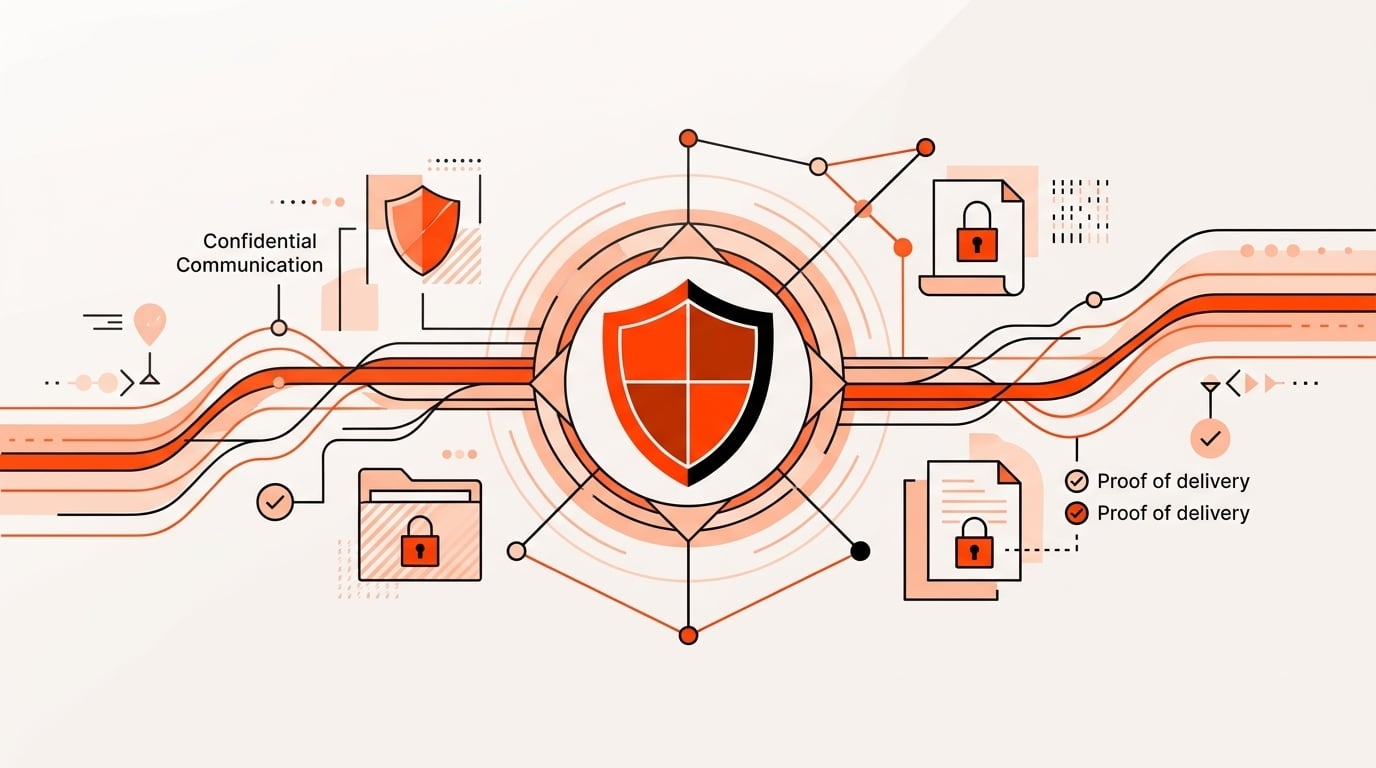
Clients entrust German law firms with their most sensitive information: merger terms, litigation strategy, findings from internal investigations. Professional secrecy lies at the heart of that relationship. A single misaddressed email or an overly broad shared link can damage that trust. How German law firms secure confidential client communication is therefore a question for the partnership, not a routine matter for the IT department.
The problem is that confidential material does not stay within the firm. It travels by email, file transfer and shared link to clients, fellow lawyers, experts, courts and insurers. Every one of those links lies outside the perimeter that firewalls and document management systems protect. Most firms cannot say with certainty who has opened what.
This article describes the architecture, governance and evidence that make confidential legal communication defensible. You will see how access control based on zero trust principles, data-centric security and a complete audit trail work together. You will also see where Zivver fits alongside the tools you already use.
Executive summary
German law firms protect confidential communication by treating every outbound exchange of sensitive data as a controlled event. Recipient verification, content-aware policy, encryption and a complete audit trail apply at the moment a document leaves the firm. They do not apply only while the document is stored.
For managing partners, CISOs and IT directors, there are three reasons to act. It reduces the attack surface created by ad hoc email and consumer file-sharing tools. It shortens investigation time when something goes wrong. It gives the firm evidence for clients, insurers and auditors that confidentiality has been actively safeguarded.
Key takeaways
- Confidential material is most vulnerable in transit. Email attachments, shared links and file transfers leave the protected environment, so security must follow the data up to the point of exchange.
- Every external recipient deserves individual verification. Verify clients, experts and fellow lawyers separately with two-factor authentication, and revoke messages as soon as access is no longer needed.
- Smart controls prevent mistakes before they become data breaches. Machine learning detects a wrong recipient and classifies sensitive content, so the firm does not depend on the sender's vigilance.
- Audit logs make confidentiality demonstrable. Recorded actions and proof of delivery show who sent, received and opened a document.
- Existing systems stay in place and gain a protective layer for outbound communication. Zivver integrates with Microsoft 365, Outlook and Gmail and does not replace your current environment.
Why confidential client communication poses a particular risk
The risk profile of a law firm differs from that of most businesses. The firm holds concentrated, high-value information from many clients at once, and its way of working constantly requires external sharing. Lawyers send draft agreements to counterparties, case files to experts and board papers to directors who read them on their phones.
Consider a realistic scenario. A mid-sized firm advises on a cross-border acquisition. Within a week, forty documents go to eight external parties, through a mix of email, a consumer file-sharing service and a USB stick handed over during a meeting. Nobody made a reckless decision. Yet the firm now cannot show where the documents went, who forwarded them, or whether recipients still have access.
That gap creates three concrete problems. Confidentiality can be lost without anyone noticing. Incident response is slow because the evidence is spread across five systems. And the firm cannot give a client a credible answer to the question of how their material was protected. The solution starts with architecture, not with yet another policy document.
A defensible architecture for confidential communication
A defensible design has three layers that work together: who has access, what may be shared, and how the exchange is protected. Firms that implement all three reduce their attack surface, because fewer uncontrolled channels remain.
Access control for clients, fellow lawyers and experts
The principle is that no recipient is trusted because of their position or because they once had access. Every external party authenticates and loses access once the work is complete. This replaces the common habit of leaving old links active indefinitely.
In practice, the firm connects its identity provider so that internal lawyers sign in through single sign-on (SAML 2.0). External recipients verify themselves with two-factor authentication, without having to create an account. This lowers the barrier for clients and increases acceptance. With Zivver, you can also revoke messages without a time limit, for example when closing a matter or after a mistake.
The measurable results are fewer lingering permissions, faster handling when a matter is closed and a clear answer when a client asks who could view their files.
Data-centric controls on confidential documents in transit
Data-centric controls look at what is being shared, not only at who is sharing it. Zivver uses machine learning for this. Smart classification recognises sensitive content and can tailor security steps accordingly. Wrong-recipient detection warns the sender before the message leaves the firm. Preventing mistakes with bcc addresses also protects against the unintended disclosure of address lists.
This matters because human judgement is the weakest link at four o'clock on a Friday afternoon. An automated check applies the same decision every time. Firms typically start with a small set of high-risk matter types, such as investigations and contested restructurings. They measure how often a warning appears and how often lawyers request an exception, and then widen the scope. A falling number of exceptions indicates that the rules fit day-to-day practice.
Encryption for email and file transfer
Encryption protects confidential content if a message or file ends up in the wrong place. Firms need this for email and file transfer, applied consistently rather than left to individual choice. Zivver applies zero-knowledge AES-256 encryption to email, both in transit and at rest. Through secure file transfer, you can send files of up to 5 TB.
The operational question is who retains control over the data. Firms with regulated clients are well advised to choose a zero-knowledge approach, in which the content of messages is not accessible to the service provider itself. Zivver is also ISO 27001 certified and has a clear focus on European regulation, including the GDPR and data sovereignty requirements. That control becomes a selling point in client assessments, where security questionnaires increasingly address these details.
Audit trails that show confidentiality was maintained
Security measures without evidence leave a firm exposed. When a client, insurer or regulator asks what happened to a confidential document, the firm must be able to answer within hours, not weeks. That requires a single place where sent messages, files and their history are recorded, rather than separate log files that someone has to merge manually.
A strong audit trail records the action, the user, the time and the object. Zivver provides audit logs and reporting on the communication that runs through the platform, supplemented by read-status monitoring. The Proof of Delivery, certified under eIDAS and ETSI, records that a message has been delivered. This proof is legally usable and is therefore a full alternative to the fax. In disputes, this is the most valuable feature. If a former employee or recipient claims never to have opened a file, the log answers that question. If a regulator or client demands proof of due care, the same log supports it.
Evidence also helps with detecting incidents. Firms often track the mean time to detect and the mean time to recover for incidents involving confidential data. Even a rough baseline helps. If it takes three days to establish what a departing employee has sent, a target of a few hours gives the security team a concrete improvement goal.
Compliance reporting then follows naturally. A well-structured log supports compliance with the GDPR and other applicable frameworks, such as NIS2 and DORA. It helps organisations demonstrate that they meet the relevant data protection requirements, because reports rely on recorded events rather than recollection.
Implementing the model in practice within the firm
Technology alone is not enough. Governance determines whether lawyers embrace the measures or work around them. Successful fir