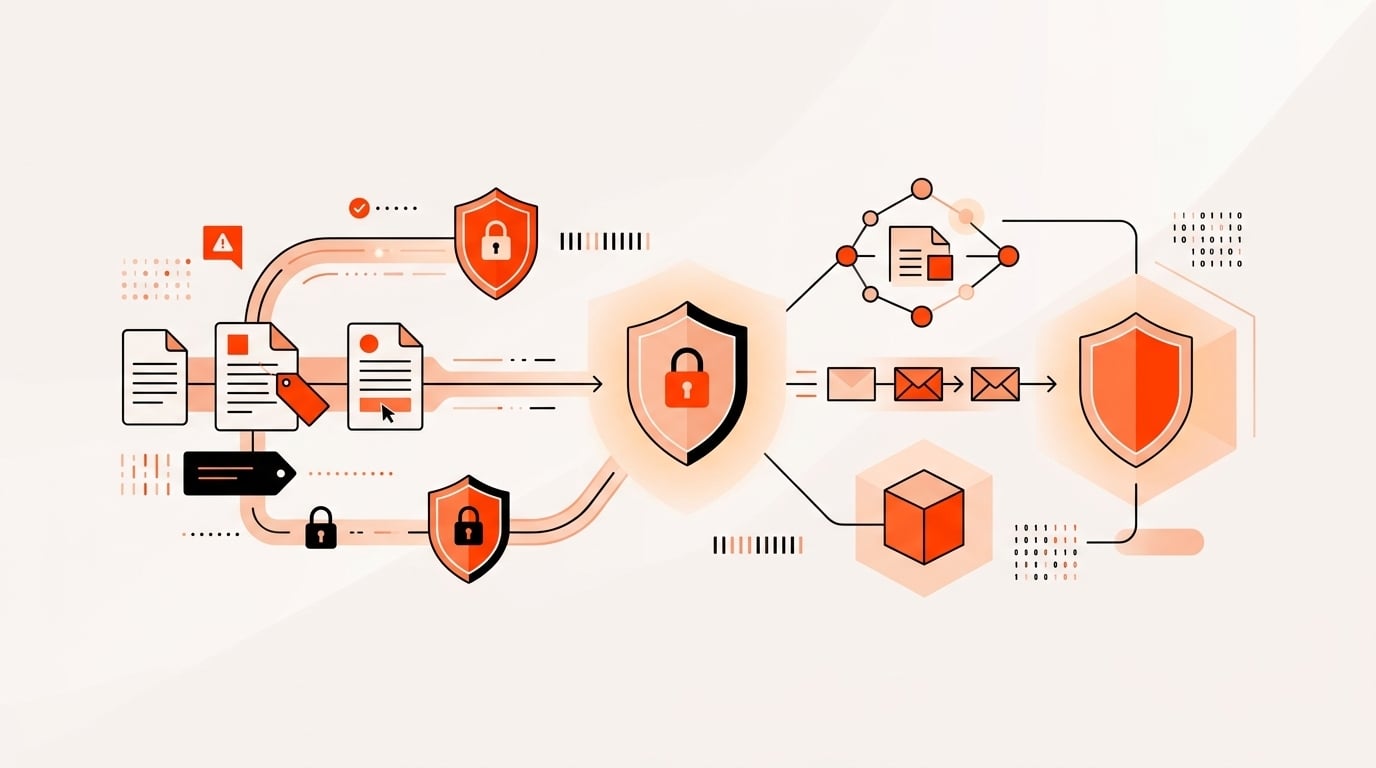
Government organisations process exceptionally sensitive data protection information that requires stringent security standards. From intelligence reports and diplomatic communications to citizen data and operational plans, these documents require classification systems that balance security requirements with operational accessibility. Poor document management creates vulnerabilities that adversaries actively exploit to compromise national security interests.
Document classification errors expose organisations to data breaches, regulatory violations and operational disruptions that undermine public trust. Security leaders need comprehensive frameworks that automate classification decisions, enforce access controls throughout document lifecycles and provide audit capabilities that demonstrate compliance with oversight requirements.
This analysis examines proven strategies for implementing robust document classification systems, establishing governance frameworks that scale across organisational departments, and operationalising security controls that protect sensitive data from creation to destruction.
Insight 1: Risk-based classification frameworks reduce manual errors whilst improving security coverage. Automated tools analyse document content and metadata to assign consistent protection levels.
Insight 2: Zero-knowledge encryption architecture validates each access request regardless of user location or authorisation level. This approach prevents unauthorised access even when traditional perimeter defences are compromised.
Insight 3: Continuous monitoring identifies classification violations and access anomalies in real-time. Early detection enables rapid remediation before security incidents escalate to broader compromise.
Insight 4: Integration with existing security tools enhances protection effectiveness across the entire technology stack. Unified platforms eliminate gaps between classification, access control and audit systems.
Insight 5: Tamper-proof audit trails provide forensic evidence for security investigations and regulatory audits. Comprehensive logging demonstrates due diligence and supports incident response activities.
Management Summary
Government document classification and security requires systematic approaches that address both current threats and evolving compliance requirements. Effective programmes combine automated classification tools with zero-trust access controls and continuous monitoring capabilities. These integrated systems reduce human error, accelerate threat detection and deliver the audit evidence required for regulatory compliance and security investigations. Success depends on implementing frameworks that scale across diverse government operations whilst maintaining the flexibility to adapt to changing security landscapes.
Establishing Risk-Based Classification Frameworks
Government organisations must implement classification systems that accurately reflect the sensitivity and protection requirements of their documents. Traditional approaches rely heavily on manual classification decisions that introduce inconsistencies and create security gaps. Modern frameworks utilise automated content analysis to assign protection levels based on document characteristics, reducing human error whilst improving classification accuracy.
Risk-based classification begins with defining clear categories that align with security policies and regulatory requirements. These categories must address different types of sensitive information, from personal data to operational intelligence. Each category requires specific handling procedures, access controls and retention policies that reflect the potential impact of unauthorised disclosure.
Automated classification systems analyse document content, metadata and context to assign appropriate protection levels. These tools examine text patterns, keywords and data structures to identify sensitive information that requires enhanced security measures. Machine learning algorithms improve classification accuracy over time by learning from user feedback and policy updates.
Integration with document creation workflows ensures classification occurs at the point of origin, reducing the risk of mishandled sensitive information. Real-time analysis provides immediate feedback to users about classification requirements and handling restrictions.
Implementing Zero-Trust Access Controls
Zero-trust architecture assumes that no user or device should be trusted automatically, regardless of location or credentials. This approach validates each access request against current security policies and user context. For government document security, zero-trust controls verify user identity, device security status and access justification before granting document access.
Dynamic access controls adjust permissions based on real-time risk assessments that consider user behaviour, location and current threat levels. These systems can restrict access during high-risk periods or when users display abnormal behaviour patterns.
Robust identity verification combines multiple authentication factors that address different attack vectors. Multi-factor authentication requirements must consider operational constraints whilst maintaining security effectiveness. Device certification ensures that only approved and properly configured systems access sensitive documents.
Contextual access policies consider multiple factors when evaluating access requests, including user role, document sensitivity, access location and current security posture. Time-based access controls restrict document availability to specific periods when access is operationally justified.
Deploying Continuous Monitoring and Threat Detection
Continuous monitoring systems track document access patterns, user behaviour and system activities to identify potential security violations. These platforms correlate multiple data sources to detect advanced attacks that might evade individual security controls. Email threat protection analysis enables rapid response to emerging threats before they can compromise sensitive information.
Behavioural analytics establish baseline patterns for normal document access and identify deviations that suggest potential security incidents. Machine learning algorithms adapt to changing user patterns whilst flagging suspicious activities for investigation.
Normal access patterns form the foundation for detecting anomalous behaviour that might indicate security threats. Historical analysis identifies typical access frequencies, document types and usage patterns for different user roles. Peer group analysis compares user behaviour with similar roles within the organisation.
Real-time detection systems analyse document access activities as they occur, enabling immediate response to security threats. Threat intelligence feeds provide current information about attack techniques that help optimise detection algorithms.
Integrating Security Systems with Enterprise Security Architecture
Government document security systems must integrate seamlessly with existing security infrastructure to provide comprehensive coverage without creating operational friction. Integration eliminates security gaps that could be exploited by advanced adversaries whilst improving operational efficiency.
Security information and event management platforms provide centralised visibility across all security systems, including document security controls. SIEM integration aggregates document access logs, classification events and security alerts into comprehensive security dashboards.
Security orchestration platforms automate response actions for common document security violations, reducing response time and ensuring consistent remediation procedures. Integration with identity management systems enables automated access adjustments based on security events.
Ensuring Audit Readiness and Regulatory Compliance
Local and central government organisations face extensive audit requirements that demand comprehensive documentation of document handling activities. Audit readiness requires systems that automatically capture detailed logs of all document access, modification and sharing activities. These records must be tamper-resistant and provide sufficient detail to support forensic analysis and regulatory reviews.
Audit trails must capture sufficient detail to reconstruct document handling activities for investigation and compliance purposes. Log entries must include user identity, access timestamps, document identifications and activity descriptions that provide clear evidence of system usage.
Regulatory examinations require rapid production of comprehensive audit evidence that demonstrates compliance with applicable requirements. Pre-configured reporting templates streamline evidence collection and ensure audit responses address all examination areas.
Operationalising Government Document Security with Advanced Security Platforms
Government organisations need integrated security platforms that combine classification automation, zero-trust access controls and comprehensive audit capabilities in unified document security systems. These platforms must address the unique requirements of government operations whilst integrating seamlessly with existing security infrastructure.
Zivver provides government organisations with a comprehensive platform for securing sensitive documents throughout their entire lifecycle. The platform combines automated classification capabilities with zero-knowledge encryption and tamper-proof audit trails that support regulatory compliance and security investigations. Data-aware controls analyse document content and context to enforce appropriate security measures regardless of how users attempt to access information.
Integration capabilities enable the platform to work alongside existing security tools including SIEM platforms, identity management systems and security orchestration tools. This approach strengthens existing security investments whilst providing specialised document security capabilities. Real-time monitoring and threat detection provide immediate visibility into document access patterns and potential security violations.
Zivver helps government organisations strengthen their document security capabilities by combining zero-knowledge encryption, ML-based human error prevention and secure large file transfer up to 5TB. Our platform integrates seamlessly with Microsoft 365 and Gmail whilst meeting BIO and NIS2 compliance requirements. Try Zivver free for 14 days or contact us for a no-obligation consultation.